



School arrival and dismissal can put pedestrians, buses, parents, cyclists, and through traffic into the same limited roadway space at nearly the same time. Across New England, those challenges can become more complicated by winter darkness, snowbanks, changing visibility, and older road layouts that were not necessarily designed around today’s pedestrian activity.
Smart traffic calming solutions can help communities make school zones and pedestrian crossings more visible while giving drivers clearer information about when and where they need to slow down.
Quick answer: Smart traffic calming for New England school zones and pedestrian crossings can combine highly visible signs, pedestrian-activated Rectangular Rapid Flashing Beacons (RRFBs), flashing beacons, radar speed displays, and variable speed limit signs. The right approach depends on roadway conditions, pedestrian movements, traffic control already in place, applicable standards, and engineering judgment. For New England municipalities and schools, equipment selection should also account for snow, changing daylight, and seasonal maintenance needs.
What New England communities should know
-
RRFBs can provide additional emphasis at qualifying marked crosswalks on uncontrolled approaches when installed according to applicable MUTCD requirements.
-
Solar-powered flashing beacons can provide conspicuous driver alerts in locations where an appropriate solar installation is practical.
-
Radar speed signs give drivers immediate feedback about their speed and can support speed-awareness efforts near schools and other pedestrian areas.
-
Winter conditions throughout Vermont, New Hampshire, Maine, Massachusetts, Connecticut, and Rhode Island make visibility, snow clearance, equipment placement, and maintenance important planning considerations.
-
No single device solves every pedestrian safety problem, so traffic calming should begin with the conditions at the individual crossing or school zone.
Why Do Smart Traffic Calming Solutions Matter in New England?
Smart traffic calming solutions matter in New England because school and pedestrian environments have to remain understandable to drivers through changing traffic, daylight, weather, and roadway conditions. A treatment that attracts attention on a clear September afternoon also needs to be considered in the context of dark winter commutes, snow accumulation, and busy arrival and dismissal periods.
Snow and ice are particularly relevant to pedestrian routes. Massachusetts Department of Conservation and Recreation winter planning, for example, specifically prioritizes certain sidewalks, pathways, and crosswalks near schools for snow and ice removal.
Roadway layouts also vary widely across the region. A school crossing in Boston’s urban street network presents different conditions from a crossing on a state or local road in rural Vermont, New Hampshire, or Maine.
That makes site-specific planning essential.
Worksafe Traffic Control Industries provides traffic control supplies and smart traffic safety solutions throughout New England. After identifying the needs of a particular location, we can help customers explore traffic safety equipment suited to the project, including RRFBs, flashing beacons, radar speed signs, variable speed limit signs, and related smart traffic technology.
What Do Regional Transportation Guidelines Tell Us?
Regional and federal transportation guidance shows that school-zone and pedestrian safety treatments need to match the roadway, crossing, and traffic-control conditions at the site. The Federal Highway Administration’s Manual on Uniform Traffic Control Devices, or MUTCD, establishes national standards and guidance for traffic control devices, while states may have additional requirements and procedures.
The current MUTCD allows pedestrian or bicyclist-activated RRFBs to supplement specified pedestrian, school, or trail warning signs at marked crosswalks across uncontrolled approaches. The MUTCD also specifies where RRFBs should and should not be used.
State requirements can differ in important ways.
Massachusetts guidance states that established school zones have a 20 mph speed limit during specified times and identifies criteria for where school zones apply. MaineDOT guidance describes Maine school-zone boundaries and the circumstances under which its 15 mph school-zone speed applies.
Those differences illustrate why New England communities should not treat traffic calming as a one-size-fits-all equipment purchase. Applicable state requirements, the MUTCD, engineering judgment, and actual site conditions should guide the final solution.
How Can Traffic Calming Affect Local School and Pedestrian Areas?
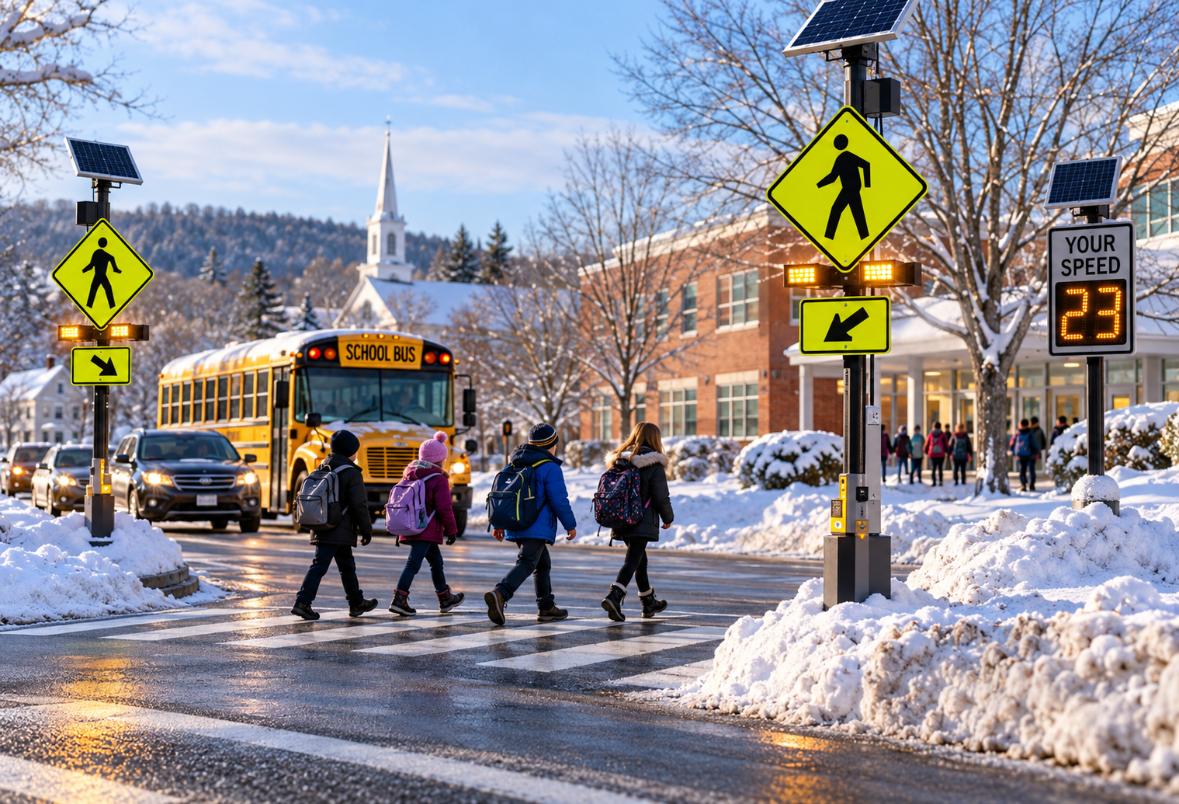
Traffic calming can make important roadway information more conspicuous and help drivers recognize locations where additional attention or lower speeds are needed. Around schools and pedestrian crossings, that can mean reinforcing an existing warning, displaying a driver’s detected speed, or activating a conspicuous beacon when someone is preparing to cross.
For a school, municipality, campus, or other public facility, the practical effects can extend beyond the device itself.
A well-planned system considers how motorists approach the area, where pedestrians cross, whether parked vehicles or snowbanks can affect sight lines, how signs remain visible, and how equipment will be powered and maintained.
These details are especially relevant in New England, where roadside conditions can look very different in January than they do at the beginning of the school year.
What Warning Signs Suggest a School Zone or Crossing Needs Review?
A school zone or pedestrian crossing should be reviewed when roadway conditions make it difficult for drivers and pedestrians to clearly recognize and respond to each other. A professional traffic evaluation can determine whether signs, beacons, speed feedback, geometric changes, or another treatment may be appropriate.
Conditions worth evaluating include:
-
Drivers regularly approaching a school or crossing faster than the intended operating environment suggests.
-
Pedestrians waiting at a marked crosswalk while approaching motorists appear slow to recognize them.
-
A crossing that becomes difficult to see during darkness, rain, snow, or other low-visibility conditions.
-
Heavy arrival and dismissal traffic that creates conflicts among buses, vehicles, cyclists, and pedestrians.
-
Existing signs that can become visually lost among roadside activity or other competing information.
-
Seasonal snowbanks or roadside conditions that can affect sight distance.
-
A school speed zone that needs clearer emphasis during the hours when its restrictions apply.
-
A crossing where community concerns indicate that a formal engineering review would be appropriate.
These observations do not automatically mean a particular device should be installed. They indicate that the location may deserve closer study.
When Should a Traffic Safety Professional Be Involved?
A traffic safety professional should be involved when a municipality, school, contractor, or property operator needs to select or implement equipment for a regulated roadway environment. Device type, placement, power requirements, activation, sign configuration, accessibility, and compatibility with existing traffic control all require careful consideration.
Basic observation can still be useful. School administrators and municipal personnel can document when pedestrian activity peaks, where people actually cross, when visibility becomes difficult, and whether changing seasons create new obstructions.
Equipment selection and roadway implementation should go further.
RRFBs, school-zone signs, speed limit displays, and other traffic control devices are subject to standards and requirements. The responsible agency and qualified professionals should determine the appropriate treatment for a specific location.
What Are Common Traffic Safety Challenges Around New England Schools?
Common New England school-zone challenges include speed management, limited visibility, concentrated arrival traffic, winter conditions, and crossings located on roads that also carry substantial through traffic. These issues can overlap, which is why combining complementary treatments may be more appropriate than focusing on one device alone.
Driver speed
A roadway can encourage speeds that feel inconsistent with pedestrian activity near a school. Radar speed displays can provide immediate feedback to approaching drivers.
Crossing visibility
Pedestrian crossings may need greater conspicuity, particularly where drivers are not otherwise controlled by a stop sign or traffic signal. At appropriate uncontrolled marked crossings, an RRFB may be one option considered.
Seasonal darkness
New England’s school year extends through months when morning and afternoon travel frequently occurs in lower-light conditions. Highly visible traffic control equipment can help reinforce the presence of a school zone or crossing.
Snow and ice
Winter maintenance can alter the roadside environment. Snowbanks can affect visibility, while snow removal operations need adequate space around signs and equipment.
Concentrated traffic
Drop-off and pickup periods can bring buses, family vehicles, pedestrians, and cyclists together within a short window. Massachusetts Safe Routes to School assessments, for example, examine interactions among walkers, bicyclists, buses, vehicles, crossing guards, and arrival and dismissal procedures.
How Can Communities Maintain Effective Traffic Calming Systems?
Communities can support effective traffic calming by routinely checking visibility, equipment condition, activation, power supply, sign condition, and seasonal obstructions. New England’s changing weather makes these inspections especially valuable before winter and again after snow season.
Useful maintenance practices include checking whether vegetation or accumulated snow obstructs signs, confirming that pedestrian activation equipment operates as intended, inspecting sign faces for damage or reduced visibility, and ensuring solar components have appropriate exposure.
After plowing operations or major storms, roadside equipment may deserve another visual inspection.
DIY maintenance should stop where electrical work, device programming, structural mounting, traffic control, or repairs require qualified personnel. A malfunctioning traffic safety device should be evaluated rather than modified informally.
What Results Should Communities Expect From Smart Traffic Solutions?
Smart traffic solutions should provide drivers with clearer, more noticeable information about the roadway condition they are approaching, but results depend on choosing the correct treatment for the site. The goal may be to emphasize a pedestrian crossing, provide speed feedback, identify an active school speed period, or improve awareness of changing conditions.
An RRFB, for example, serves a different purpose from a radar speed display. A variable speed limit sign addresses a different need from a standard flashing warning beacon.
Defining the problem first makes it easier to select technology that serves a clear traffic-management purpose.
What Mistakes Should Communities Avoid?
The most common traffic calming mistakes involve selecting equipment before defining the roadway problem, overlooking applicable requirements, or failing to plan for maintenance. New England’s seasonal conditions make long-term planning particularly important.
Mistake: Choosing technology because it is highly visible.
Consequence: The device may not address the actual traffic or pedestrian issue.
Better approach: Start with the site’s operating conditions and intended safety function.
Mistake: Treating every crosswalk the same.
Consequence: A device appropriate at one crossing may not be appropriate at another.
Better approach: Review traffic control, roadway geometry, pedestrian activity, and applicable standards.
Mistake: Ignoring winter maintenance.
Consequence: Snow storage or plowing operations can interfere with visibility or access.
Better approach: Consider year-round maintenance during planning and placement.
Mistake: Installing equipment without a maintenance strategy.
Consequence: A system can become less useful if damage, power problems, or visibility issues are not addressed.
Better approach: Establish inspection and service responsibilities from the beginning.
What Is a Common New England School-Zone Scenario?
A common New England scenario is a marked school crossing on a local road that experiences a short but intense increase in pedestrian and vehicle activity during arrival and dismissal. The same location may also face darker winter mornings, roadside snow accumulation, and drivers who use the road as a through route.
A review might consider existing signs, pedestrian routes, observed speeds, sight distance, roadway control, and seasonal conditions.
Depending on the findings and applicable requirements, potential solutions could include improved signage, flashing beacons, radar speed feedback, an RRFB at a qualifying crossing, or another traffic calming treatment.
This is a representative scenario, not a specific Worksafe project or a recommendation for any particular roadway.
Which Smart Traffic Solutions Can Support School Zones and Crossings?
Smart traffic solutions for school zones and pedestrian crossings can include RRFBs, solar-powered flashing beacons, radar speed signs, and variable speed limit signs. Each technology communicates something different, so selecting equipment should follow the needs identified at the location.
Our smart traffic product options include pedestrian-activated RRFBs designed for marked crossing applications, solar or AC-powered flashing beacons, solar-powered radar speed signs, and variable speed limit signs that can display limits according to scheduling needs.
We also provide broader smart traffic technology and traffic control equipment for New England customers.
How Do the Main Traffic Calming Options Compare?
The main traffic calming options differ primarily in what they communicate to drivers and when they communicate it. Understanding that function helps municipalities and schools narrow their choices before determining which treatment is appropriate under applicable standards.
| Solution | Primary Function | Potential Application |
|---|---|---|
| RRFB | Adds conspicuous pedestrian-activated flashing emphasis | Qualifying marked crossings on uncontrolled approaches |
| Flashing beacon | Draws attention to an important warning or traffic message | School, pedestrian, municipal, and other warning applications |
| Radar speed sign | Displays detected vehicle speed | Locations where speed awareness is a priority |
| Variable speed limit sign | Displays a speed limit that can change according to approved operating needs | School zones and other locations with changing limits |
| Standard signs and markings | Communicate regulatory, warning, and guidance information | Foundational traffic control throughout the roadway system |
The final choice should be based on engineering judgment and applicable federal, state, and local requirements.
Where Does Worksafe Provide Smart Traffic Solutions?
We provide traffic control products and smart traffic solutions throughout New England, serving customers across Vermont, New Hampshire, Maine, Massachusetts, Connecticut, and Rhode Island. Our corporate headquarters is in Barre, Vermont, and our New Hampshire division is in Bow, helping us serve projects across northern and southern New England.
What Can Happen When a Traffic Safety Concern Is Left Unaddressed?
An unresolved traffic safety concern can continue creating uncertainty or conflict at the same school zone or pedestrian crossing, especially during periods of heavy activity or reduced visibility. Waiting can also mean another winter or school year passes without determining whether existing traffic control still fits current conditions.
The appropriate response is not necessarily adding more equipment. A review may show that signs need attention, sight lines have changed, a crossing deserves further engineering evaluation, or a different traffic calming strategy should be considered.
FAQ About New England School-Zone and Pedestrian Traffic Calming
Are RRFBs appropriate for every New England pedestrian crossing?
No, RRFBs are not appropriate for every pedestrian crossing. Under the MUTCD, their use is tied to specific marked-crosswalk applications and traffic-control conditions. A municipality or responsible roadway agency should evaluate the crossing and applicable requirements before choosing an RRFB or another pedestrian treatment.
Can smart traffic equipment operate during New England winters?
Traffic safety equipment can be selected for year-round applications, but New England winter conditions need to be considered during planning and maintenance. Snow accumulation, plowing, visibility, mounting locations, power requirements, and access for maintenance should all be evaluated so the installation remains practical throughout the year.
What is the difference between an RRFB and a flashing school-zone beacon?
An RRFB provides a specific rapid-flashing warning treatment associated with qualifying marked crossing applications, while other flashing beacons can emphasize different traffic warnings or messages. The devices are not interchangeable simply because both use flashing lights. The appropriate application depends on the traffic-control situation and applicable standards.
Can radar speed signs help around New England schools?
Radar speed signs can support speed-awareness efforts by showing approaching drivers their detected speed. They may be considered where speed feedback serves the goals identified for the site. Placement, sign configuration, and use should be coordinated with the roadway authority and applicable traffic-control requirements.
Are school-zone speed rules the same across New England?
No, school-zone rules are not identical across all six New England states. State laws, transportation-agency procedures, roadway jurisdiction, and local conditions can affect how school zones are established and operated. Massachusetts and Maine guidance alone demonstrates differences in school-zone speed requirements, making state-specific review essential.
Should New England communities choose solar or AC-powered flashing equipment?
The right power source depends on the location, available infrastructure, equipment requirements, and site conditions. Solar can be useful where a suitable installation has adequate exposure, while AC power may make sense where electrical infrastructure is available. Seasonal shading and winter conditions should be considered when evaluating solar equipment.
When is the best time to inspect school-zone equipment in New England?
School-zone equipment should be inspected routinely, with additional attention before the school year, before winter, and after severe weather or roadside maintenance activity. These checks can identify damaged signs, visibility problems, obstructed solar components, or equipment issues before seasonal conditions make maintenance more difficult.
Can one traffic calming device solve a busy school-zone problem?
One device may address a specific problem, but complex school-zone conditions often require a broader evaluation. Driver speed, crossing location, pedestrian routes, buses, parent traffic, sight distance, signs, markings, and seasonal conditions can all affect the roadway environment. The solution should match the specific issues identified at the site.
Build a Clearer, More Visible School-Zone or Crossing Environment
New England school zones and pedestrian crossings need traffic safety solutions that make sense for the roadway, the people using it, and the region’s year-round conditions. We can help municipalities, schools, contractors, and other organizations explore smart traffic equipment suited to their project needs.