



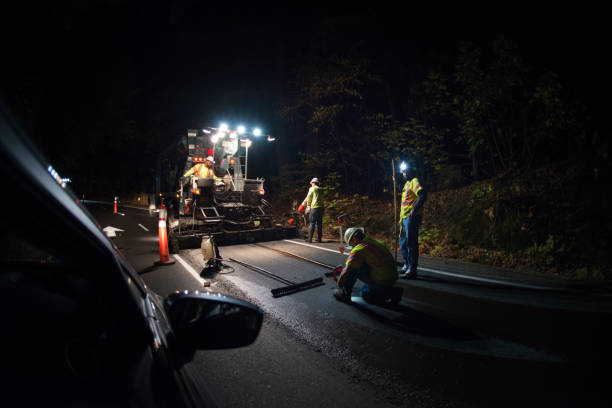
Road construction doesn’t always stop when the sun goes down. Throughout Vermont and the surrounding New England states, highway crews, utility contractors, and municipal maintenance teams frequently work overnight to complete repairs, maintain infrastructure, and minimize disruptions to daytime traffic. While nighttime schedules can offer practical advantages, they also introduce safety challenges that require careful planning.
Reduced visibility, passing vehicles, changing weather conditions, and limited natural light can make nighttime roadwork particularly demanding. Workers need to see their surroundings clearly, equipment operators need unobstructed views of active work areas, and approaching motorists need enough warning to recognize temporary traffic patterns.
Nighttime road construction safety depends on combining appropriate work zone lighting, high-visibility clothing, and properly positioned traffic control devices. No single product can eliminate every hazard, but selecting the right equipment and using it correctly can support safer working conditions.
Important elements of a nighttime safety plan include:
- Adequate illumination: Portable lighting should help workers see equipment, walking surfaces, and active construction areas without creating excessive glare.
- High-visibility apparel: Workers need appropriately rated clothing that makes them easier to recognize in low-light conditions.
- Visible traffic warnings: Reflective construction signs and arrow boards help approaching drivers identify lane closures and traffic changes.
- Clearly defined work zones: Barricades and channelizing devices help separate active construction areas from moving traffic.
- Regular inspections: Crews should verify lighting, reflective materials, and traffic control equipment before and during nighttime operations.
At Worksafe Traffic Control Industries, we help contractors, public works departments, utility companies, and transportation agencies throughout New England select road construction safety equipment. With our headquarters in Barre, VT, and an additional location in Bow, NH, we offer lighting systems, safety apparel, traffic signs, barricades, arrow boards, and other equipment for temporary traffic control.
Why Does Nighttime Road Construction Require Additional Safety Precautions?
Nighttime road construction requires additional safety precautions because reduced visibility affects how quickly drivers and workers can recognize hazards. Headlight glare, shadows, fatigue, and changing traffic patterns can further complicate operations, making appropriate lighting, reflective apparel, and traffic control particularly important.
Reduced Visibility for Drivers and Workers
During daylight hours, workers can typically see approaching vehicles, equipment, and surrounding hazards more clearly.
After dark, headlights and portable lights become the primary sources of illumination. Areas outside their reach may remain difficult to see, particularly along highway shoulders or around construction equipment.
For crews working along Interstate 89 near Barre or Montpelier, maintaining clear visibility is essential when traffic continues moving past the work zone.
Headlight Glare and Shadows
Bright lighting isn’t automatically effective lighting.
Poorly positioned floodlights can shine into approaching drivers’ eyes or create strong shadows that conceal people and equipment.
Lighting plans should consider the direction of traffic, work activities, and placement of vehicles and machinery.
Changing New England Weather
Vermont road crews also encounter fog, rain, snow, and rapidly changing temperatures.
Wet pavement can reflect artificial light, while precipitation may reduce visibility.
For nighttime maintenance operations, equipment selection and placement should account for these changing conditions rather than relying on the same setup for every project.
What Are the Work Zone Lighting Requirements for Nighttime Construction?
Work zone lighting requirements depend on the nature of the operation, applicable traffic control standards, and the tasks workers must perform. The Federal Highway Administration’s Manual on Uniform Traffic Control Devices, or MUTCD, provides guidance for illuminating nighttime work areas and establishes specific requirements for nighttime flagger stations.
Lighting Active Work Areas
The MUTCD recommends using floodlights to illuminate work areas, equipment crossings, and other locations where nighttime construction activities occur.
Lighting should be sufficient for workers to recognize nearby hazards and perform their assigned tasks.
The amount and positioning of illumination depend on the operation. General maintenance work may require different lighting from detailed equipment repair or precision construction activities.
Illuminating Flagger Stations
Under the MUTCD, nighttime flagger stations must be illuminated except in emergency situations.
Proper lighting helps approaching motorists recognize flaggers and their signals.
However, illumination must be positioned to avoid interfering with a driver’s view of the flagger or surrounding roadway.
Preventing Excessive Glare
The MUTCD recommends evaluating floodlight placement by observing the illuminated work zone from approaching traffic directions at night.
This helps identify glare, shadows, and visibility problems that may not be apparent during daylight setup.
For safety managers overseeing road work safety at night, this is an important part of reviewing the completed traffic control arrangement.
Requirements can also vary according to state-adopted standards, contract specifications, and project-specific traffic control plans. Vermont contractors should confirm applicable Vermont Agency of Transportation requirements before beginning work.
How Do Portable Construction Light Towers Improve Work Zone Visibility?
Portable construction light towers improve nighttime visibility by providing adjustable illumination for construction activities, equipment movement, and surrounding work areas. Their mobility makes them useful for temporary projects where permanent lighting isn’t available or where the work zone changes throughout the operation.
Solar-Powered Light Towers
Our portable solar light towers provide an alternative to conventional fuel-powered lighting equipment.
We offer trailer-mounted solar lighting options, including the Portable Solar Light Tower 4000S and 6000S.
The 4000S is a compact system designed for applications such as work zones, parking lots, and other areas requiring temporary illumination.
The 6000S features six adjustable lamps and a rotating solar panel, making it another option for projects requiring broader lighting coverage.
Solar systems can reduce dependence on fuel-powered generators, although operating performance depends on battery capacity, charging conditions, lighting demand, and other equipment specifications.
For contractors managing nighttime construction lighting in Vermont, these factors should be evaluated before selecting a unit.
Trolley-Mounted Light Towers
Trolley-mounted lighting provides another option for projects where equipment size and maneuverability are important.
These systems can be useful when crews need to position lighting within a limited working area or relocate equipment as operations progress.
For municipal road maintenance or utility work in downtown Barre, for example, available space may influence which lighting configuration is appropriate.
Choosing the Right Light Tower
The right unit depends on several factors, including the size of the work area, intended operating hours, access restrictions, and power requirements.
Light placement must also account for overhead obstructions, traffic movement, and the potential for glare.
At Worksafe Traffic Control Industries, we can help customers compare available lighting equipment and identify options suited to their project requirements.
Our specific trailer-mounted light tower products are offered for purchase rather than rental.
Why Is High-Visibility Clothing Essential for Nighttime Construction Workers?
High-visibility clothing for construction workers helps motorists and equipment operators recognize people working near moving vehicles and machinery. During nighttime operations, properly designed retroreflective materials are especially important because they return light toward its source, helping workers remain visible when illuminated by vehicle headlights.
Understanding Fluorescent and Reflective Materials
Fluorescent fabrics improve conspicuity in daylight and certain low-light conditions.
Retroreflective materials serve a different purpose by reflecting light back toward its source.
For nighttime roadwork, the combination of appropriate garment colors and retroreflective materials supports worker recognition.
A vest that appears bright during the day isn’t necessarily suitable for every nighttime highway application.
ANSI/ISEA 107 Performance Classes
High-visibility garments are categorized according to performance requirements established by the ANSI/ISEA 107 standard.
The MUTCD identifies Performance Class 2 or 3 apparel for workers within temporary traffic control zones in the roadway right-of-way, subject to specified exceptions.
It also recommends Performance Class 3 apparel for nighttime flaggers.
However, choosing the appropriate garment requires evaluating the work activity, exposure conditions, and applicable requirements.
Selecting Appropriate Construction Safety Vests
Construction safety vests should be selected based on the worker’s responsibilities and the conditions of the job site.
A flagger near active traffic may have different apparel needs from a worker operating equipment within a separated construction area.
At our Barre location, we supply reflective safety vests and other high-visibility workwear for traffic control and construction applications.
We encourage purchasing managers to verify garment labeling, relevant standards, sizing, and job-specific requirements rather than assuming every reflective vest provides equivalent protection.
How Do Traffic Signs, Arrow Boards, and Barricades Support Nighttime Safety?
Traffic signs, arrow boards, and barricades support nighttime road construction safety by helping drivers recognize work zones, understand changing traffic patterns, and navigate temporary restrictions. These devices work alongside lighting and high-visibility clothing to create a more complete traffic control arrangement.
Reflective Construction Signs
Temporary construction signs provide advance warning of lane closures, workers, equipment, and altered traffic conditions.
For nighttime use, signs must meet applicable visibility and retroreflectivity or illumination requirements.
Proper placement is especially important along rural Vermont highways, where approaching drivers may encounter a work zone after travelling through long stretches of unlit roadway.
Arrow Boards
Arrow boards help communicate lane closures and merging directions.
These devices are particularly useful on multilane roadways where drivers need advance guidance before approaching a restricted travel lane.
We offer trailer-mounted and vehicle-mounted arrow board options that can support different temporary traffic control applications.
Barricades and Channelizing Devices
Barricades, cones, and other channelizing devices help define the boundaries of an active work zone.
Their placement should follow the approved traffic control plan and applicable standards.
For utility work in Burlington or highway maintenance near White River Junction, combining appropriately positioned devices with lighting can help establish clearer separation between traffic and workers.
Our equipment selection includes barricades, warning signs, and other work zone safety products for temporary and ongoing operations.
Common Nighttime Construction Safety Mistakes to Avoid
Common nighttime construction safety mistakes include inadequate illumination, poorly positioned floodlights, unsuitable reflective clothing, and failure to inspect traffic control equipment. These problems can make hazards harder to recognize and interfere with the effectiveness of an otherwise carefully planned work zone.
Positioning Lights Without Checking for Glare
A light tower may illuminate a work area effectively while creating problems for approaching drivers.
Before beginning operations, supervisors should evaluate the arrangement from relevant roadway approaches.
If glare or deep shadows are present, lighting positions may need adjustment.
Using Worn or Inappropriate Safety Apparel
Reflective workwear can become damaged, dirty, or less effective through use.
Supervisors should inspect garments regularly and replace items that no longer meet the necessary condition or visibility requirements.
Workers should also wear clothing appropriate for weather conditions without covering required reflective materials.
Overlooking Equipment Inspections
Lighting equipment, arrow boards, warning lights, and other devices require routine checks.
For solar-powered equipment, inspections may include battery charge, lamp operation, panel condition, and mounting hardware.
Safety managers should also verify that traffic control devices remain correctly positioned throughout the shift.
Relying on Lighting Alone
Illumination is only one component of a nighttime safety plan.
Protective barriers, appropriate work practices, traffic control arrangements, training, and high-visibility apparel remain important.
No lighting system or safety vest can eliminate the risk associated with moving vehicles and construction equipment.
How Should New England Contractors Prepare for Nighttime Roadwork?
New England contractors should prepare for nighttime roadwork by reviewing their traffic control plans, evaluating lighting needs, selecting appropriate worker apparel, and inspecting equipment before crews begin operations. Preparation should also account for seasonal conditions and any changes expected during the shift.
A practical pre-shift checklist includes:
- Review the approved traffic control plan and applicable project requirements.
- Identify areas requiring additional illumination.
- Verify that flagger stations have appropriate lighting.
- Inspect high-visibility clothing and replace damaged garments.
- Test light towers, arrow boards, and warning lights.
- Confirm signs and barricades are positioned correctly.
- Evaluate glare and shadows from approaching traffic directions.
- Review weather conditions and any necessary operational adjustments.
For municipalities managing nighttime roadway maintenance near Rutland, St. Johnsbury, or central Vermont communities, keeping this checklist consistent can support more organized equipment preparation.
Contractors working across state lines should also verify requirements for the specific jurisdiction and project.
Why Choose Worksafe Traffic Control Industries for Nighttime Safety Equipment?
Our experience supplying traffic control equipment throughout New England helps contractors, transportation agencies, and municipal departments evaluate products for specific roadway applications. From portable lighting to reflective safety apparel, we offer equipment intended to support organized temporary traffic control operations.
A Broad Selection of Traffic Safety Products
Our available product categories include:
- Portable solar light towers.
- Trailer-mounted and trolley-mounted lighting equipment.
- Reflective safety vests and high-visibility workwear.
- Construction and temporary traffic control signs.
- Trailer-mounted and vehicle-mounted arrow boards.
- Barricades and traffic control accessories.
- Other roadway warning and work zone safety equipment.
This selection allows customers to discuss multiple equipment needs with one supplier.
Guidance for Equipment Selection
Every nighttime construction project has different requirements.
The appropriate lighting solution for a rural highway maintenance operation may differ from the equipment needed for a municipal intersection or utility repair.
Our team can help customers compare product features, discuss intended applications, and identify suitable equipment options.
Serving Vermont and the Broader New England Region
We operate from our headquarters at 115 Industrial Lane in Barre, VT, with an additional division in Bow, NH.
We serve customers throughout Vermont, New Hampshire, Maine, Massachusetts, and other New England markets.
Whether you’re preparing for a highway project or purchasing equipment for ongoing municipal maintenance, we’re available to discuss your traffic control needs.
Frequently Asked Questions About Nighttime Road Construction Safety
1. What is the most important safety equipment for nighttime road construction?
Nighttime construction requires a coordinated combination of appropriate lighting, high-visibility apparel, reflective traffic signs, channelizing devices, and other controls specified for the work zone. No single product is sufficient for every project, so equipment selection should reflect the job’s hazards and applicable requirements.
2. Are construction workers in Vermont required to wear reflective safety vests at night?
Workers in temporary traffic control zones generally must wear high-visibility apparel meeting applicable performance requirements, subject to specific exceptions. Under the MUTCD, Performance Class 2 or 3 apparel is identified for covered workers, with Class 3 recommended for nighttime flaggers.
3. Are portable solar light towers suitable for Vermont highway projects?
Portable solar light towers may be suitable for certain highway construction and maintenance applications. Supervisors should evaluate illumination needs, battery performance, charging conditions, operating duration, and equipment placement before selecting a model.
4. Does Worksafe offer construction light tower rentals in Barre, VT?
Our specific trailer-mounted light tower products are not available for rental. We offer lighting equipment for purchase and can help customers review available models to determine which option may be suitable for their work zone.
5. What are the nighttime work zone lighting requirements in New England?
Requirements vary according to the project’s location, traffic control standards, and specific work activities. The MUTCD provides nighttime illumination guidance and requires lighting at flagger stations except in emergency situations. Contractors should also review applicable state and project specifications.
6. Why is Class 3 high-visibility clothing recommended for nighttime flaggers?
Class 3 apparel provides additional visible and retroreflective material, supporting recognition of a worker’s body shape and movement. The MUTCD recommends this performance class for nighttime flaggers, although the appropriate garment must still be selected according to the work conditions and applicable standards.
7. Can Worksafe supply arrow boards and traffic signs for New Hampshire projects?
Yes. We supply construction signs, arrow boards, barricades, and other traffic control products to customers throughout New Hampshire and the surrounding New England region. Our Bow, NH, division provides an additional point of contact for regional customers.
8. How can safety managers reduce glare from construction lighting?
Safety managers can reduce glare by positioning lights away from approaching drivers’ direct sightlines, adjusting lamp angles, and evaluating the setup at night. The MUTCD recommends observing the illuminated work zone from approaching roadway directions to identify visibility problems.
Equip Your New England Road Crews for Safer Nighttime Operations
Nighttime road construction requires more than simply turning on a few floodlights and placing reflective signs along the roadway. Contractors and public works departments must consider how drivers recognize temporary traffic patterns, whether workers remain visible, and how lighting affects the surrounding work area. From the busy interstate corridors of Vermont to municipal streets throughout New England, thoughtful equipment selection can support better visibility and more organized nighttime operations. Properly positioned light towers, suitable reflective apparel, and correctly installed traffic control devices all contribute to a more comprehensive approach to work zone safety.
At Worksafe Traffic Control Industries, we’re committed to helping transportation agencies, contractors, and municipalities find equipment that matches their operational requirements. From our headquarters in Barre and our New Hampshire division, we supply portable lighting systems, reflective workwear, construction signs, arrow boards, barricades, and other essential traffic control products. Whether you’re preparing for a major highway project or updating your department’s existing safety equipment, our team is ready to discuss available options and help you make informed purchasing decisions.
Contact Worksafe Traffic Control Industries today to explore nighttime construction lighting, high-visibility clothing, and road construction safety equipment for your next New England project.